Présentation de l'éditeur
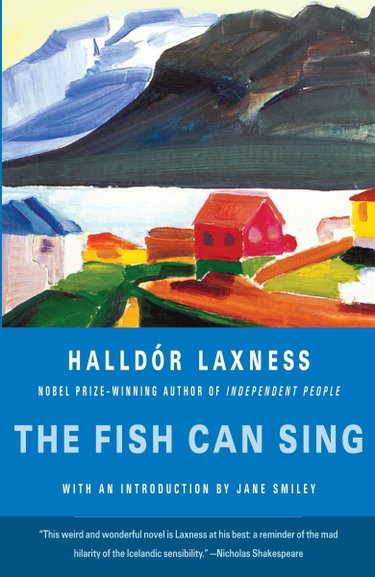
The Fish Can Sing is one of Nobel Prize winner Halldór Laxness’s most beloved novels, a poignant coming-of-age tale marked with his peculiar blend of light irony and dark humor.
The orphan Alfgrimur has spent an idyllic childhood sheltered in the simple turf cottage of a generous and eccentric elderly couple. Alfgrimur dreams only of becoming a fisherman like his adoptive grandfather, until he meets Iceland's biggest celebrity. The opera singer Gardar Holm’s international fame is a source of tremendous pride to tiny, insecure Iceland, though no one there has ever heard him sing. A mysterious man who mostly avoids his homeland and repeatedly fails to perform for his adoring countrymen, Gardar takes a particular interest in Alfgrimur’s budding musical talent and urges him to seek out the world beyond the one he knows and loves. But as Alfgrimur discovers that Gardar is not what he seems, he begins to confront the challenge of finding his own path without turning his back on where he came from.
Extrait
1
STRANGE CREATURE
A wise man once said that next to losing its mother, there is nothing more healthy for a child than to lose its father. And though I would never subscribe to such a statement wholeheartedly, I would be the last person to reject it out of hand. For my own part, I would express such a doctrine without any suggestion of bitterness against the world, or rather without the hurt which the mere sound of the words implies.
But whatever one might think of the merits of this observation, it so happened in my own case that I had to make do without any parents at all. I will not say that it was actually my good fortune - that would be putting it too strongly; but I certainly cannot call it a misfortune, at least not so far as I myself was concerned, and that was because I acquired a grandfather and a grandmother instead. It might be closer to the truth to say that the misfortune was all my father's and my mother's: not because I would have been a model son to them, far from it, but because parents have even more need of children than children have of parents. But that is another matter.
Anyway, to cut a long story short, I must tell you that to the south of the churchyard in our future capital city of Reykjavik, just where the slope begins to level out at the southern end of the Lake, on the exact spot where Gudmundur Gudmunsen (the son of old Jon Gudmundsson, the owner of Gudmunsen's Store) eventually built himself a fine mansion-house - on this patch of ground there once stood a little turf-and-stone cottage with two wooden gables facing east towards the Lake; and this little place was called Brekkukot.
This was where my grandfather lived, the late Bjorn of Brekkukot who sometimes went fishing for lumpfish in spring-time; and with him lived the woman who has been closer to me than most other women, even though I knew nothing about her: my grandmother. This little turf cottage was a free and ever-open guest-house for anyone and everyone who had need of shelter. At the time when I was coming into this world, the cottage was crowded with people who would nowadays be called refugees - people who flee their country, people who abandon their native homes and hearths in tears because conditions at home are so desperate that their children cannot survive infancy.
Then one day, so I have been told, it happened that a young woman arrived at the place from somewhere in the west; or north; or perhaps even east. This woman was on her way to America, abandoned and destitute, fleeing from those who ruled over Iceland. I have heard that her passage had been paid for by the Mormons, and indeed I know for a fact that among them are to be found some of the finest people in America. But anyway, without further ado, this woman I mentioned gave birth to a baby while she was staying at Brekkukot waiting for her ship. And when she had been delivered of the child she looked at her newborn son and said, "This