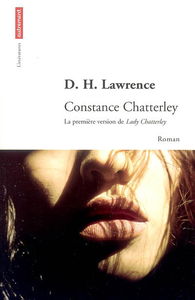
Présentation de l'éditeur An authoritative edition of what D.H. Lawrence called "the most improper novel in the world"With her soft brown hair, lithe figure and big, wondering eyes, Constance Chatterley is possessed of a certain vitality. Yet she is deeply unhappy; married to an invalid, she is almost as inwardly paralysed as her husband Clifford is paralysed below the waist. It is not until she finds refuge in the arms of Mellors the game-keeper, a solitary man of a class apart, that she feels regenerated. Together they move from an outer world of chaos towards an inner world of fulfillment. Included here, in his essay A Propos of Lady Chatterley's Lover, are Lawrence's own, final thoughts on male-female relationships in the modern world. This Penguin edition reproduces the newly established Cambridge text, the first edition ever to restore to Lawrence's most famous work the words he wrote and the first to correct authoritatively the 1928 Florence edition which Lawrence personally supervised.For more than seventy years, Penguin has been the leading publisher of classic literature in the English-speaking world. With more than 1,700 titles, Penguin Classics represents a global bookshelf of the best works throughout history and across genres and disciplines. Readers trust the series to provide authoritative texts enhanced by introductions and notes by distinguished scholars and contemporary authors, as well as up-to-date translations by award-winning translators. Extrait Chapter One Ours is essentially a tragic age, so we refuse to take it tragically. The cataclysm has happened, we are among the ruins, we start to build up new little habits, to have new little hopes. It is rather hard work: there is now no smooth road into the future: but we go round, or scramble over the obstacles. We’ve got to live, no matter how many skies have fallen.This was more or less Constance Chatterley’s position. The war had brought the roof down over her head. And she had realized that one must live and learn.She married Clifford Chatterley in 1917, when he was home for a month on leave. They had a month’s honeymoon. Then he went back to Flanders: to be shipped over to England again six months later, more or less in bits. Constance, his wife, was then twenty-three years old, and he was twenty-nine.His hold on life was marvellous. He didn’t die, and the bits seemed to grow together again. For two years he remained in the doctor’s hands. Then he was pronounced a cure, and could return to life again, with the lower half of his body, from the hips down, paralyzed for ever.This was in 1920. They returned, Clifford and Constance, to his home, Wragby Hall, the family “seat.” His father had died, Clifford was now a baronet, Sir Clifford, and Constance was Lady Chatterley. They came to start housekeeping and married life in the rather forlorn home of the Chatterleys on a rather inadequate income. Clifford had a sister, but she had departed. Otherwise there were no near relatives. The elder brother was dead in the war. Crippled for ever, knowing he could never have any children, Clifford came home to the smoky Midlands to keep the Chatterley name alive while he could.He was not really downcast. He could wheel himself about in a wheeled chair, and he had a bath-chair with a small motor attachment, so he could drive himself slowly round the garden and into the fine melancholy park, of which he was really so proud, though he pretended to be flippant about it.Having suffered so much, the capacity for suffering had to some extent left him. He remained strange and bright and cheerful, almost, one might say, chirpy, with his ruddy, healthy-looking face, and his pale-blue, challenging bright eyes. His shoulders were broad and strong, his hands were very strong. He was expensively dressed, and wore handsome neckties from Bond Street. Yet still in his face one saw the watchful look, the slight vacancy of a cripple.He had so very nearly lost his life, tha