Présentation de l'éditeur
"Once upon a time, there was a woman who discovered that she had turned into the wrong person." So Anne Tyler opens this irresistible new novel.
The woman is Rebecca Davitch, a fifty-three-year-old grandmother. Is she an impostor in her own life? she asks herself. Is it indeed her own life? Or is it someone else’s?
On the surface, Beck, as she is known to the Davitch clan, is outgoing, joyous, a natural celebrator. Giving parties is, after all, her vocation—something she slipped into even before finishing college, when Joe Davitch spotted her at an engagement party in his family’s crumbling nineteenth-century Baltimore row house, where giving parties was the family business. What caught his fancy was that she seemed to be having such a wonderful time. Soon this large-spirited older man, a divorcé with three little girls, swept her into his orbit, and before she knew it she was embracing his extended family plus a child of their own, and hosting endless parties in the ornate, high-ceilinged rooms of The Open Arms.
Now, some thirty years later, after presiding over a disastrous family picnic, Rebecca is caught un-awares by the question of who she really is. How she answers it—how she tries to recover her girlhood self, that dignified grownup she had once been—is the story told in this beguiling, funny, and deeply moving novel.
As always with Anne Tyler’s novels, once we enter her world it is hard to leave. But in
Back When We Were Grownups she so sharpens our perceptions and awakens so many untapped feelings that we come away not only refreshed and delighted, but also infinitely wiser.
Extrait
ONE
Once upon a time, there was a woman who discovered she had turned into the wrong person.
She was fifty-three years old by then—a grandmother. Wide and soft and dimpled, with two short wings of dry, fair hair flaring almost horizontally from a center part. Laugh lines at the corners of her eyes. A loose and colorful style of dress edging dangerously close to Bag Lady.
Give her credit: most people her age would say it was too late to make any changes. What's done is done, they would say. No use trying to alter things at this late date.
It did occur to Rebecca to say that. But she didn't.
. . .
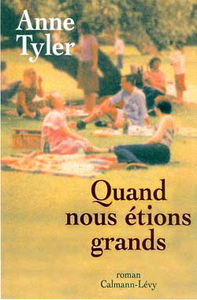
On the day she made her discovery, she was picnicking on the North Fork River out in Baltimore County. It was a cool, sunny Sunday in early June of 1999, and her family had gathered to celebrate the engagement of Rebecca's youngest stepdaughter, NoNo Davitch.
The Davitches' cars circled the meadow like covered wagons braced for attack. Their blankets dotted the grass, and their thermos jugs and ice chests and sports equipment crowded the picnic table. The children were playing beside the river in one noisy, tumbling group, but the adults kept themselves more separate. Alone or in twos they churned about rearranging their belongings, jockeying for spots in the sun, wandering off hither and yon in their moody Davitch manner. One of the stepdaughters was sitting by herself in her minivan. One of the sons-in-law was stretching his hamstrings over by the runners' path. The uncle was stabbing the ground repeatedly with his cane.
Goodness, what would Barry think? (Barry, the new fiancé.) He would think they disapproved of his marrying NoNo.
And he would be right.
Not that they ever behaved much differently under any conditions.
Barry had a blanket mostly to himself, because NoNo kept flitting elsewhere. The tiniest and prettiest of the Davitch girls—a little hummingbird of a person—she darted first to one sister and then another, ducking her shiny dark cap of hair and murmuring something urgent.
Murmuring, "Like him, please," maybe. Or, "At least make him feel welcome."
The first sister grew very busy rummaging through a straw hamper. The second shaded her eyes and pretended to look for the children.
Rebecca—who earned her living hosting parties, after all—felt she had no choice but to clap her hands and c