Présentation de l'éditeur
A young man and woman meet, love each other, and are consumed. It’s a story as old as romance itself, but in this enthralling novel John Burnham Schwartz tells it with heart-stopping new immediacy. In the middle of a rainstorm Julian Rose, a self-effacing Harvard graduate student, takes refuge beneath a girl’s yellow umbrella. The girl, the woman, is Claire Marvel, lovely, mercurial, mired in family tragedy. She is the last person someone like Julian should fall in love with. But he does.
What ensues is a great and difficult passion strewn with obstacles–not least those arising from Claire and Julian’s disparate characters. And as these young people find and lose each other, then seek each other anew, Schwartz places romantic love within an entire continuum of attachments that require the full reserves of our openness and courage.
Extrait
1
There was before her and now there is after her, and that is the difference in my life.
I will begin here because there can be no other beginning for this story. It was the middle of May, 1985. I was walking along Union Street on my way to see a professor one Monday afternoon when the weather turned suddenly. The sky broke open and rain poured down. I sprinted for cover, my book bag thudding against my ribs, reaching the Fogg Art Museum just as the rain became a torrent.
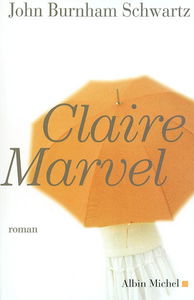
There was a rushing sound as I ran, and a flash of golden yellow.
I reached the museum's low front steps. Standing there watching me from under an umbrella the color of buttercups was a young woman.
"I hate to be the bearer of bad news. But the Fogg's closed Mondays."
Still breathing hard from my sprint I shook my head. Rain the size of Tic-Tacs was pelting me; water was leaking out of my hair and down the back of my neck. I rubbed a sopping shirtsleeve across my face.
She began to laugh, not unkindly. Against the gray stone building and storm-darkened sky her pale face gleamed like bone china.
"Sorry," she said after a while.
"It's okay."
"It's just that you're really, unbelievably wet."
Raising the umbrella a few inches higher she offered me a place beside her.
I hesitated. Hazel eyes alive with amusement; a refined nose above a mouth of promising fullness; straight brown hair falling to the middle of her back; a body slender and lithe. I kept glancing at her, then down at the ground. She wore sandals and the hems of her jeans were frayed and her toenails unpainted and a sexy, glistening wash of spattered rain shone on the pale tops of her feet.
I stepped under the umbrella.
"Better, isn't it? Bring your bag under, too. Don't want your great thoughts getting wet."
Her irony was nimble, inviting. I lifted the flap of my stuffed book bag and showed her my inventory: Party Systems and Voter Alignments (5th ed., 1967); A Theory of Parties and Electoral Systems (1981); Political Parties and the Modern State, (1984). A well-thumbed paperback of Bellow's Seize the Day. Also the current issues of Foreign Affairs and The Harvard Gazette, a spiral notebook, five ballpoint pens, a fluorescent highlighter, and half a roll of LifeSavers. Everything damp, of course, from the rain.
Reading the titles she raised an eyebrow but said nothing.
"It's all right," I assured her. "This isn't the first conversation killed off by my interests."
"Oh, I'm pretty sure Bellow's never killed anybody," she said, "except maybe one or two of his ex-wives." She reached for the book. On the cover there was a black-and-white photograph of the back of a man's head, no face, just a hat visible, a pale fedora with a dark band, the hat tilted up in an angle of recognition or perhaps even of wonder at a skyscraper rising in the background. "Seize the Day's not bad," she said, slipping the book back into the bag. "But you should be reading Herzog. The others--well, I'm sure they're fascinating."
I began to close the bag, then changed my mind. "Want a LifeSaver?"
She cocked her head skeptically. "Depends on the