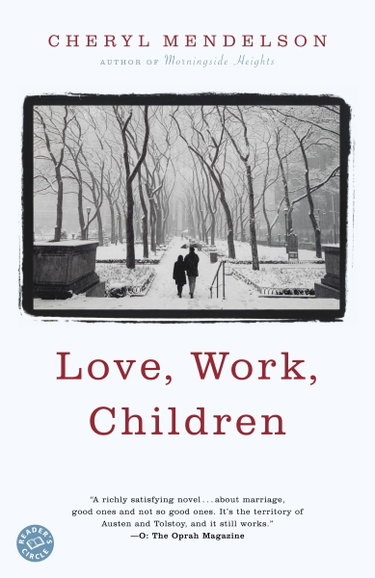
Présentation de l'éditeur
Morningside Heights, a Manhattan neighborhood sandwiched between Columbia University and the Hudson River, is home to an eclectic mix of academics, struggling artists, and rooted families. In this distinctive world, Peter Frankel, a successful partner in a prestigious law firm, lives a seemingly contented life with his talented wife and his two Ivy League—educated children.
Yet in middle age Peter finds himself discontent. His wife’s narrowness and her preoccupation with appearances leaves him cold, his job does not fulfill his creative bent, and he fears that his children, Susan and Louis, have grown into skeptical young adults who shun marriage and stability.
So when Peter’s wife is badly hurt in a car accident and lies in a coma, he finds himself guiltily relieved–and newly drawn toward his children as they too struggle with ambivalent feelings about the mother who’s never really shown them much love. As Susan, a cerebral doctoral student, becomes unhappily involved with an aspiring playwright and Louis is caught up in a futile pursuit of an ambitious journalist, Peter’s own quiet life is shaken up, and longings he has stifled for years come rumbling to the surface.
Freed from his wife’s judgments, Peter throws himself into his greatest pleasure, the work he does for a foundation that funds offbeat artistic projects. And as his passion for this work ignites, so does his desire for another woman. But the stubborn morality that has steered Peter’s life is a force to be reckoned with–and one from which he may never entirely escape.
Love, Work, Children is a profoundly insightful novel about two generations and the colorful urban world they inhabit. A superb portrayal of one of New York’s exceptional neighborhoods, this is a story, ultimately, about the self-imposed obstacles to true happiness–and a testament to the joy one can find in overcoming them.
Extrait
CHAPTER 1
Four Forty-four Riverside Drive, a fine old residential building in Morningside Heights, was filled with aging couples whose grown children remained unmarried. The phenomenon was so general that it had begun to be openly talked of. Not so long ago, the Frankls and the Holmeses, whose daughters had been best friends all their lives, had been congratulating themselves on how successfully they had taught their children not to rush into marriage and how this augured well for their ultimate happiness. But now that the children were all around thirty, their restraint began to look like indifference and their unmarried state like a permanent one.
Until now, their sixtyish parents had led placid lives. Peter Frankl was a lawyer who, with his wife, Lesley, lived in one of the building’s two penthouses, with forty feet of windows framing sunsets over the Hudson. The Holmeses, Herbert and Ingrid, were both psychotherapists. They had a pleasant corner apartment on the fourth floor, from which, in winter when the trees were bare, they could see a few gleaming inches of the river. Neither the Frankls nor the Holmeses had money worries or health problems; all of them had significant careers except Lesley, who, however, painted contentedly in a home studio and now and then sold a canvas.
Peter Frankl’s marriage wasn’t all he would have liked. But he had put the children first, ensuring that they grew up in the calm of civil and secure family life, and deemed his marital problems tolerable. The Holmeses, by contrast, had one of those extraordinarily close, warm marriages that succeed through an unlikely amalgam of egoism and altruism, which, although rare and peculiar, is inevitably regarded as ordinary—perhaps because such unions are as boring and offputting to others as they are satisfying to the married pair itself.
The tenderly reared offspring of these couples had grown up to be everything their fathers and mothers could wish for. The children’s happiness and safety was the sweetest part of their parents’ lives and the rock on wh