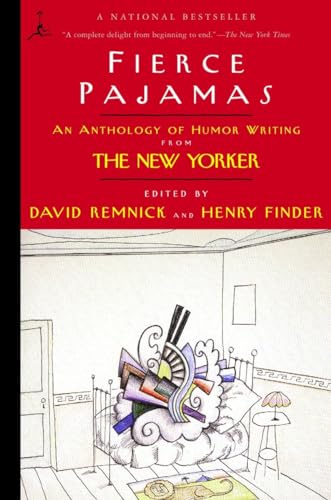
Présentation de l'éditeur
When Harold Ross founded The New Yorker in 1925, he called it a “comic weekly.” And although it has become much more than that, it has remained true in its irreverent heart to the founder’s description, publishing the most illustrious literary humorists in the modern era—among them Robert Benchley, Dorothy Parker, Groucho Marx, James Thurber, S. J. Perelman, Mike Nichols, Woody Allen, Calvin Trillin, Garrison Keillor, Ian Frazier, Roy Blount, Jr., Steve Martin, and Christopher Buckley. Fierce Pajamas is a treasury of laughter from the magazine W. H. Auden called the “best comic magazine in existence.”
Extrait
SPOOFS
WOLCOTT GIBBS
DEATH IN THE RUMBLE SEAT WITH THE USUAL APOLOGIES TO ERNEST HEMINGWAY,
WHO MUST BE PRETTY SICK OF THIS SORT OF THING
Most people don’t like the pedestrian part, and it is best not to look at that if you can help it. But if you can’t help seeing them, long-legged and their faces white, and then the shock and the car lifting up a little on one side, then it is best to think of it as something very unimportant but beautiful and necessary artistically. It is unimportant because the people who are pedestrians are not very important, and if they were not being cogido by automobiles it would just be something else. And it is beautiful and necessary because, without the possibility of somebody getting cogido, driving a car would be just like anything else. It would be like reading “Thanatopsis,” which is neither beautiful nor necessary, but hogwash. If you drive a car, and don’t like the pedestrian part, then you are one of two kinds of people. Either you haven’t very much vitality and you ought to do something about it, or else you are yellow and there is nothing to be done about it at all.
If you don’t know anything about driving cars you are apt to think a driver is good just because he goes fast. This may be very exciting at first, but afterwards there is a bad taste in the mouth and the feeling of dishonesty. Ann Bender, the American, drove as fast on the Merrick Road as anybody I have ever seen, but when cars came the other way she always worked out of their terrain and over in the ditch so that you never had the hard, clean feeling of danger, but only bumping up and down in the ditch, and sometimes hitting your head on the top of the car. Good drivers go fast too, but it is always down the middle of the road, so that cars coming the other way are dominated, and have to go in the ditch themselves. There are a great many ways of getting the effect of danger, such as staying in the middle of the road till the last minute and then swerving out of the pure line, but they are all tricks, and afterwards you know they were tricks, and there is nothing left but disgust.
The cook: I am a little tired of cars, sir. Do you know any stories?
I know a great many stories, but I’m not sure that they’re suitable.
The cook: The hell with that.
Then I will tell you the story about God and Adam and naming the animals. You see, God was very tired after he got through making the world. He felt good about it, but he was tired so he asked Adam if he’d mind thinking up names for the animals.
“What animals?” Adam said.
“Those,” God said.
“Do they have to have names?” Adam said.
“You’ve got a name, haven’t you?” God said.
I could see–
The cook: How do you get into this?
Some people always write in the first person, and if you do it’s very hard to write any other way, even when it doesn’t altogether fit into the context. If you want to hear this story, don’t keep interrupting.
The cook: O.K.
I could see that Adam thought God was crazy, but he didn’t say anything. He went over to where the animals were, and after a while he came back with the list of names.
“Here you are,” he said.
God read the list, and nodded.
“They’re pretty good,” he said. “They’re all pretty good except that last one.”
“That’s a good name,” Adam said. “What’s the matter with it?”
“What do you want to call it an e
Caractéristiques
Éditions :Random House Publishing Group
Nombre de pages :528
ISBN :9780375761270
Date de publication :15 octobre 2002
Dimensions (L x H x E cm) :3 X 23.5 X 15.6
Poids (g) :544
Reliure :Broché
Produit indisponible !
Nous n'avons plus d'exemplaire disponible pour le moment mais chaque jour nous remettons plus de
8000 produits en stock.