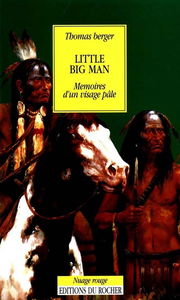
Présentation de l'éditeur
“The truth is always made up of little particulars which sound ridiculous when repeated.” So says Jack Crabb, the 111-year-old narrator of Thomas Berger’s 1964 masterpiece of American fiction, Little Big Man. Berger claimed the Western as serious literature with this savage and epic account of one man’s extraordinary double life.
After surviving the massacre of his pioneer family, ten-year-old Jack is adopted by an Indian chief who nicknames him Little Big Man. As a Cheyenne, he feasts on dog, loves four wives, and sees his people butchered by horse soldiers commanded by General George Armstrong Custer. Later, living as a white man once more, he hunts the buffalo to near-extinction, tangles with Wyatt Earp, cheats Wild Bill Hickok, and fights in the Battle of Little Bighorn alongside Custer himself—a man he’d sworn to kill. Hailed by The Nation as “a seminal event,” Little Big Man is a singular literary achievement that, like its hero, only gets better with age.
Praise for Little Big Man
“An epic such as Mark Twain might have given us.”—Henry Miller
“The very best novel ever about the American West.”—The New York Times Book Review
“Spellbinding . . . [Crabb] surely must be one of the most delightfully absurd fictional fossils ever unearthed.”—Time
“Superb . . . Berger’s success in capturing the points of view and emotional atmosphere of a vanished era is uncanny. His skill in characterization, his narrative power and his somewhat cynical humor are all outstanding.”—The New York Times
Extrait
CHAPTER 1 A Terrible Mistake
I AM A WHITE MAN and never forgot it, but I was brought up by the Cheyenne Indians from the age of ten.
My Pa had been a minister of the gospel in Evansville, Indiana. He didn’t have a regular church, but managed to talk some saloonkeeper into letting him use his place of a Sunday morning for services. This saloon was down by the riverfront and the kind of people would come in there was Ohio River boatmen, Hoosier fourflushers on their way to New Orleans, pickpockets, bullyboys, whores, and suchlike, my Pa’s favorite type of congregation owing to the possibilities it afforded for the improvement of a number of mean skunks.
The first time he come into the saloon and started to preach, that bunch was fixing to lynch him, but he climbed on top of the bar and started to yell and in a minute or two they all shut up and listened. My Pa could handle with his voice any white man that ever lived, though he was only of the middle height and skinny as a pick handle. What he’d do, you see, was to make a person feel guilty of something they never thought of. Distraction was his game. He’d stare with his blazing eyes at some big, rough devil off the boats and shout: “How long’s it been you ain’t seen your old Ma?” Like as not that fellow would scrape his feet and honk his nose in his sleeve, and when my brothers and sisters carried around cleaned-out spittoons for the collection, remember us kindly for our pains.
Pa split the collection with the saloonkeeper, which was part of the reason he was let to use the place. The other part was that the bar stayed open throughout the service. My Pa wasn’t no Puritan. He’d take a shot or three himself right while he was preaching, and was never known to say a word against the drink, or women, or cards, or any of the pleasures. “Every kind of sport has been invented by the Lord and therefore can’t be bad in itself,” he would say. “It’s only bad when the pursuit of it makes a man into a mean skunk who will cuss and spit and chew and never wash his face.” These were the only specific sins I ever heard my Pa mention. He never minded a cigar, but was dead set against chewing tobacco, foul language, and dirt on a person. So long as a man was clean, my Pa didn’t care whether he drank himself to death, gambled away every cent so that his kids starved, or got sick from frequenting low women.
I never suspected it at that time, being just a young boy, but I