Présentation de l'éditeur
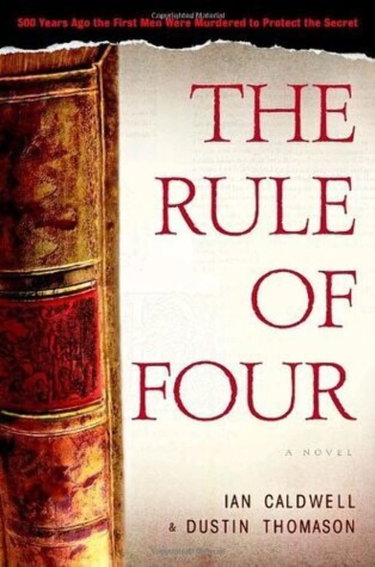
An ivy league murder, a mysterious coded manuscript, and the secrets of a Renaissance prince collide memorably in
The Rule of Four—a brilliant work of fiction that weaves together suspense and scholarship, high art and unimaginable treachery.
It's Easter at Princeton. Seniors are scrambling to finish their theses. And two students, Tom Sullivan and Paul Harris, are a hair's breadth from solving the mysteries of the Hypnerotomachia Poliphili—a renowned text attributed to an Italian nobleman, a work that has baffled scholars since its publication in 1499. For Tom, their research has been a link to his family's past—and an obstacle to the woman he loves. For Paul, it has become an obsession, the very reason for living. But as their deadline looms, research has stalled—until a long-lost diary surfaces with a vital clue. And when a fellow researcher is murdered just hours later, Tom and Paul realize that they are not the first to glimpse the Hypnerotomachia 's secrets.
Suddenly the stakes are raised, and as the two friends sift through the codes and riddles at the heart of the text, they are beginnning to see the manuscript in a new light—not simply as a story of faith, eroticism and pedantry, but as a bizarre, coded mathematical maze. And as they come closer and closer to deciphering the final puzzle of a book that has shattered careers, friendships and families, they know that their own lives are in mortal danger. Because at least one person has been killed for knowing too much. And they know even more.
From the streets of fifteenth-century Rome to the rarified realm of the Ivy League, from a shocking 500 year-old murder scene to the drama of a young man's coming of age,
The Rule of Four takes us on an entertaining, illuminating tour of history—as it builds to a pinnacle of nearly unbearable suspense.
Extrait
Chapter One
Strange thing, time. It weighs most on those who have it least. Nothing is lighter than being young with the world on your shoulders; it gives you a feeling of possibility so seductive, you know there must be something more important you could be doing than studying for exams.
I can see myself now, the night it all began. I'm lying back on the old red sofa in our dorm room, wrestling with Pavlov and his dogs in my introductory psychology book, wondering why I never fulfilled my science requirement as a freshman like everyone else. A pair of letters sits on the coffee table in front of me, each containing a vision of what I could be doing next year. The night of Good Friday has fallen, cold April in Princeton, New Jersey, and with only a month of college left I'm no different from anyone else in the class of 1999: I'm having trouble getting my mind off the future.
Charlie is sitting on the floor by the cube refrigerator, playing with the Magnetic Shakespeare someone left in our room last week. The Fitzgerald novel he's supposed to be reading for his final paper in English 151w is spread open on the floor with its spine broken, like a butterfly somebody stepped on, and he's forming and re-forming sentences from magnets with Shakespearean words on them. If you ask him why he's not reading Fitzgerald, he'll grunt and say there's no
point. As far as he's concerned, literature is just an educated man's shell game, three-card monte for the college crowd: what you see is never what you get. For a science-minded guy like Charlie, that's the height of perversity. He's headed for medical school in the fall, but the rest of us are still hearing about the C-plus he found on his English midterm in March.
Gil glances over at us and smiles. He's been pretending to study for an economics exam, but Breakfast at Tiffany's is on, and Gil has a thing for old films, especially ones with Audrey Hepburn. His advice to Charlie was simple: if you don't want to read the book, then rent the movie. They'll never know. He's probably right, but Charlie sees something dishonest in that, and anyway it would