Présentation de l'éditeur
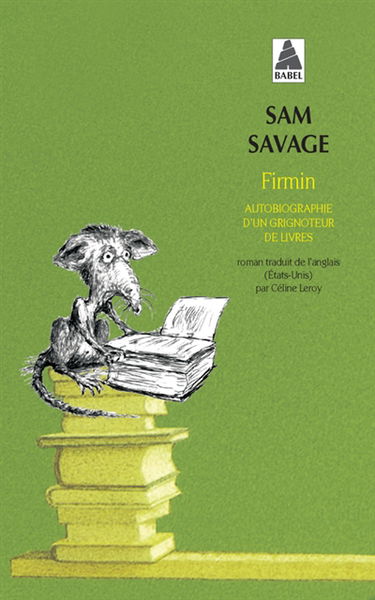
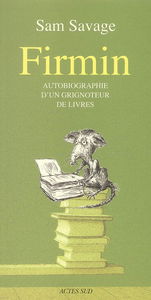
In the basement of a Boston bookstore, Firmin is born in a shredded copy Finnegans Wake, nurtured on a diet of Zane Grey, Lady Chatterley’s Lover, and Jane Eyre (which tastes a lot like lettuce). While his twelve siblings gnaw these books obliviously, for Firmin the words, thoughts, deeds, and hopes—all the literature he consumes—soon consume him. Emboldened by reading, intoxicated by curiosity, foraging for food, Firmin ventures out of his bookstore sanctuary, carrying with him all the yearnings and failings of humanity itself. It’s a lot to ask of a rat—especially when his home is on the verge of annihilation.
A novel that is by turns hilarious, tragic, and hopeful, Firmin is a masterpiece of literary imagination. For here, a tender soul, a vagabond and philosopher, struggles with mortality and meaning—in a tale for anyone who has ever feasted on a book…and then had to turn the final page.
Extrait
Chapter One
I had always imagined that my life story, if and when I wrote it, would have a great first line: something lyric like Nabokov's "Lolita, light of my life, fire of my loins"; or if I could not do lyric, then something sweeping like Tolstoy's "All happy families are alike, but every unhappy family is unhappy in its own way." People remember those words even when they have forgotten everything else about the books. When it comes to openers, though, the best in my view has to be the beginning of Ford Madox Ford's The Good Soldier: "This is the saddest story I have ever heard." I've read that one dozens of times and it still knocks my socks off. Ford Madox Ford was a Big One.
In all my life struggling to write I have struggled with nothing so manfully—yes, that's the word, manfully—as with openers. It has always seemed to me that if I could just get that bit right all the rest would follow automatically. I thought of that first sentence as a kind of semantic womb stuffed with the busy embryos of unwritten pages, brilliant little nuggets of genius practically panting to be born. From that grand vessel the entire story would, so to speak, ooze forth. What a delusion! Exactly the opposite was true. And it is not as if there weren't any good ones. Savor this, for example: "When the phone rang at 3:00 a.m. Morris Monk knew even before picking up the receiver that the call was from a dame, and he knew something else too: dames meant trouble." Or this: "Just before being hacked to pieces by Gamel's sadistic soldiers, Colonel Benchley had a vision of the little whitewashed cottage in Shropshire, and Mrs. Benchley in the doorway, and the children." Or this: "Paris, London, Djibouti, all seemed unreal to him now as he sat amid the ruins of yet another Thanksgiving dinner with his mother and father and that idiot Charles." Who can remain unimpressed by sentences like these? They are so pregnant with meaning, so, I dare say, poignant with it that they positively bulge with whole unwritten chapters—unwritten, but there, already there!
Alas, in reality they were nothing but bubbles, illusions every one. Each of the wonderful phrases, so full of promise, was like a gift-wrapped box clutched in a small child's eager hand, a box that holds nothing but gravel and bits of trash, though it rattles oh so enticingly. He thinks it is candy! I thought it was literature. All those sentences—and many, many others as wel—proved to be not springboards to the great unwritten novel but insurmountable barriers to it. You see, they were too good. I could never live up to them. Some writers can never equal their first novel. I could never equal my first sentence. And look at me now. Look how I have begun this, my final work, my opus: "I had always imagined that my life story, if and when . . ." Good God, "if and when"! You see the problem. Hopeless. Scratch it.
This is the saddest story I have ever heard. It begins, like all true stories, who knows where. Looking for the beginning is like trying to discover the source of a