Présentation de l'éditeur
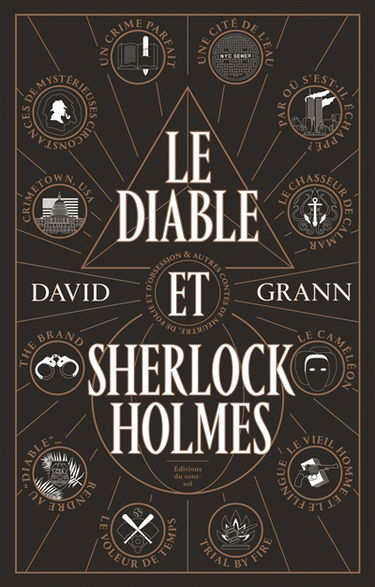
Acclaimed New Yorker writer and author of the breakout debut bestseller The Lost City of Z, David Grann offers a collection of spellbinding narrative journalism.
Whether he’s reporting on the infiltration of the murderous Aryan Brotherhood into the U.S. prison system, tracking down a chameleon con artist in Europe, or riding in a cyclone- tossed skiff with a scientist hunting the elusive giant squid, David Grann revels in telling stories that explore the nature of obsession and that piece together true and unforgettable mysteries.
Each of the dozen stories in this collection reveals a hidden and often dangerous world and, like Into Thin Air and The Orchid Thief, pivots around the gravitational pull of obsession and the captivating personalities of those caught in its grip. There is the world’s foremost expert on Sherlock Holmes who is found dead in mysterious circumstances; an arson sleuth trying to prove that a man about to be executed is innocent; and sandhogs racing to complete the brutally dangerous job of building New York City’s water tunnels before the old system collapses. Throughout, Grann’s hypnotic accounts display the power—and often the willful perversity—of the human spirit.
Compulsively readable, The Devil and Sherlock Holmes is a brilliant mosaic of ambition, madness, passion, and folly.
Extrait
Mysterious Circumstances
Richard Lancelyn Green, the world’s foremost expert on Sherlock Holmes, believed that he had finally solved the case of the missing papers. Over the past two decades, he had been looking for a trove of letters, diary entries, and manuscripts written by Sir Arthur Conan Doyle, the creator of Holmes. The archive was estimated to be worth nearly four million dollars, and was said by some to carry a deadly curse, like the one in the most famous Holmes story, “The Hound of the Baskervilles.”
The papers had disappeared after Conan Doyle died, in 1930, and without them no one had been able to write a definitive biography—a task that Green was determined to complete. Many scholars feared that the archive had been discarded or destroyed; as the London Times noted, its whereabouts had become “a mystery as tantalizing as any to unfold at 221B Baker Street,” the fictional den of Holmes and his fellow-sleuth, Dr. Watson.
Not long after Green launched his investigation, he discovered that one of Conan Doyle’s five children, Adrian, had, with the other heirs’ agreement, stashed the papers in a locked room of a château that he owned in Switzerland. Green then learned that Adrian had spirited some of the papers out of the château without his siblings’ knowledge, hoping to sell them to collectors. In the midst of this scheme, he died of a heart attack—giving rise to the legend of the curse. After Adrian’s death, the papers apparently vanished. And whenever Green tried to probe further he found himself caught in an impenetrable web of heirs—including a self-styled Russian princess—who seemed to have deceived and double-crossed one another in their efforts to control the archive.
For years, Green continued to sort through evidence and interview relatives, until one day the muddled trail led to London—and the doorstep of Jean Conan Doyle, the youngest of the author’s children. Tall and elegant, with silver hair, she was an imposing woman in her late sixties. (“Something very strong and forceful seems to be at the back of that wee body,” her father had written of Jean when she was five. “Her will is tremendous.”) Whereas her brother Adrian had been kicked out of the British Navy for insubordination, and her elder brother Denis was a playboy who had sat out the Second World War in America, she had become an officer in the Royal Air Force, and was honored, in 1963, as a Dame Commander of the Order of the British Empire.
She invited Green into her flat, where a portrait of her father, with his walrus mustache, hung near the fireplace. Green had almost as great an interest in her fath