Biographie de l'auteur
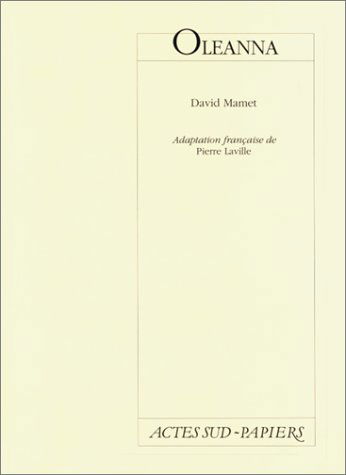
David Mamet (b. 1947) is an award-winning American playwright and screenwriter. His first and many subsequent plays were first performed by the St Nicholas Theatre company, Chicago, of which he was a founding member and Artistic Director. In 1978 he became Associate Artistic Director of the Goodman Theatre, Chicago, where American Buffalo had been first staged in 1975, subsequently winning an Obie Award and opening on Broadway in 1977 and at the National Theatre, London, in 1978. His greatest hits, Glengarry Glen Ross and Oleanna, followed in 1983 and 1993 respectively. Other works by Mamet published by Methuen Drama include David Mamet Collected Plays 1-4; American Buffalo; Sexual Perversity in Chicago; Duck Variations; A Life in the Theatre; Edmond; The Cryptogram; Reunion; The Woods; The Water Engine; Lakeboat; The Disappearance of the Jews; Speed-the-Plow; Three Uses of the Knife, and Dr. Faustus.
Présentation de l'éditeur
"The finest American playwright of his generation" (Sunday Times)
Reunion shows the meeting between a father and daughter after nearly twenty years of separation: "It would be hard to over-praise the way Mr Mamet suggests behind the probing, joshing family chat, an extraordinary sense of pain and loss. . .although the play has a strong social comment about the destructively cyclical effect of divorce, it is neither sour nor defeatist" (Guardian); In Dark Play, a father tells his five-year-old daughter a story about an Indian boy and his pony "a subtle, lyrical, dreamlike vignette" (Star Tribune); in The Woods, a young man and woman spend the night in a cabin together "a beautifully conceived love story" (Chicago Daily News); Lakeboat portrays eight crew members of a merchant ship exchanging wild fantasies about sex, gambling and violence "Richly overheard talk. . .loopy, funny construction." (Village Voice); Edmond is an odyssey through the disturbing, suspended dark void of a contemporary New York "it is also a technically adventurous piece pared brilliantly to the bone, highly theatrical in its scenic elisions." (Financial Times)