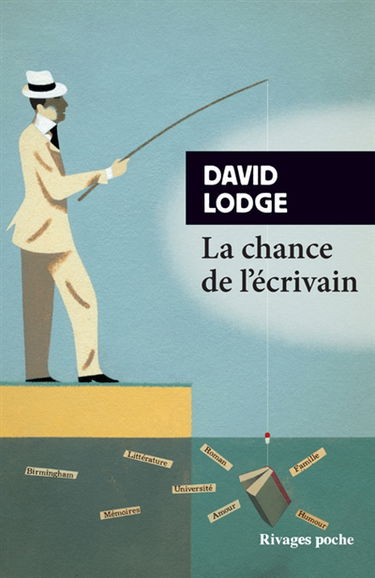
Présentation de l'éditeur
Ralph Messenger is a man who knows what he wants and generally gets it. Approaching his fiftieth birthday, he has good reason to feel pleased with himself. As Director of the prestigious Holt Belling Centre for Cognitive Science at the University of Gloucester he is much in demand as a pundit on developments in artificial intelligence and the study of human consciousness - 'the last frontier of scientific enquiry'. He enjoys an affluent life style subsidised by the wealth of his American wife, Carrie. Known to colleagues on the conference circuit as a womaniser and to Private Eye as a 'Media Dong', he has reached a tacit understanding with Carrie to refrain from philandering in his own back yard.This resolution is already weakening when he meets and is attracted to Helen Reed, a distinguished novelist still grieving for the sudden death of her husband more than a year ago, who has rented out her London house and taken up a post as writer-in residence at Gloucester University, partly to try and get over her bereavement.Fascinated and challenged by a personality and a world-view radically at odds with her own, Helen is aroused by Ralph's bold advances, but resists on moral principle. The stand-off between them is shattered by a series of events and discoveries that dramatically confirm the truth of Ralph's dictum, 'We can never know for certain what another person is thinking.'
Amazon.fr
In Thinks..., David Lodge writes another witty satire on the vagaries and triumphs of contemporary British academic life and achieves a fine balance between multiple points of narrative interest. He gains much momentum from psychologically nuanced romantic intrigue, and also manages to offer intelligent speculation on the state of play in the scientific and philosophical investigations into the nature and workings of human consciousness, without preaching or becoming ponderous. Thinks... recounts the experiences of Helen Reed, distinguished novelist, who accepts a creative writing teaching gig at the fictional University of Gloucester after the sudden death of her husband. Here she meets Ralph Messenger, scholar, spin doctor, philanderer and head of the illustrious Colt Belling Centre for Cognitive Science. Scientist and novelist spar: She asks them what they were working on. Jim says robotics, Carl says affective modelling. Kenji says something indistinct that Ralph repeats for her benefit--genetic algorithms. "I can guess what robotics is," says Helen, "but what on earth are the others?" Carl explains that affective modelling is computer simulation of the way emotions affect human behaviour. "Like grief?" Helen says, glancing at Ralph. "Exactly so," he says. "Though Carl is actually working on a program for mother-love." "I'd like to see it," says Helen. "I am not able to give a demonstration, I'm afraid," says Carl. "I am rewriting the program." The form of the novel carefully mirrors its intellectual concerns. We are given Ralph's attempts to tape-record his random thoughts; Helen's more introspective diary and the often hilarious writing assignments of Helen's motley crew of students, who attempt literary solutions to the problems Ralph poses Helen. Written with enviable deftness, Thinks... manages to be generous to its characters and serious about the intellectual and ethical questions it poses for itself without losing satiric bite. --Neville Hoad
Extrait
One, two, three, testing, testing . . . recorder working OK . . . Olympus Pearlcorder, bought it at Heathrow in the dutyfree on my way to . . . where? Can't remember, doesn't matter . . . The object of the exercise being to record as accurately as possible the thoughts that are passing through my head at this moment in time, which is, let's see . . . 10.13 a.m. on Sunday the 23rd of Febru—San Diego! I bought it on my way to that conference in . . . Isabel Hotchkiss. Of course, San Diego, 'Vision and the Brain'. Late eighties. Isabel Hotchkiss. I tested