Présentation de l'éditeur
A literary event: one of the most celebrated novels ever written, in a magnificent new translation
Seven years ago, the incomparable Lydia Davis brought us an award-winning, rapturously reviewed new translation of Marcel Proust's
Swann's Way that was hailed as "clear and true to the music of the original" (
Los Angeles Times) and "a work of creation in its own right" (Claire Messud,
Newsday). Now she turns her gifts to the book that defined the novel as an art form.
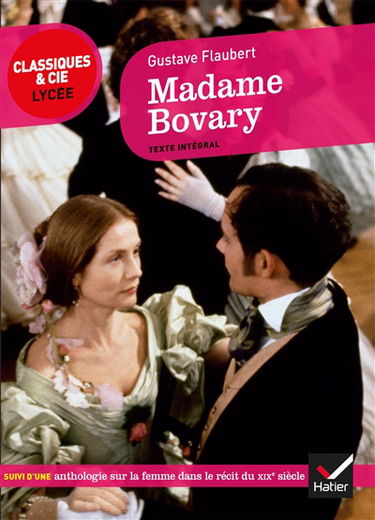
When Emma Rouault marries dull, provincial doctor Charles Bovary, her dreams of an elegant and passionate life crumble. She escapes into sentimental novels but finds her fantasies dashed by the tedium of her days. Motherhood proves to be a burden; religion is only a brief distraction. She spends lavishly and embarks on a series of disappointing affairs. Soon heartbroken and crippled by debts, Emma takes drastic action with tragic consequences for her husband and daughter. When published in 1857,
Madame Bovary was embraced by bourgeois women who claimed it spoke to the frustrations of their lives. Davis's landmark translation gives new life in English to Flaubert's masterwork.
Extrait
[1]
We were in Study Hall, when the Headmaster entered, followed by a new boy dressed in regular clothes and a school servant carrying a large desk. Those who were sleeping woke up, and everyone rose as though taken by surprise while at work.
The Headmaster motioned us to sit down again; then, turning to the study hall teacher:
"Monsieur Roger," he said to him in a low voice, "here is a pupil I am entrusting to your care; he is entering the fifth. If his work and his conduct are deserving, he will be moved up to the seniors, as befits his age."
Still standing in the corner, behind the door, so that one could hardly see him, the new boy was a fellow from the country, about fifteen years old, and taller than any of us. His hair was cut straight across the forehead, like a village choirboy's, his manner sensible and very ill at ease. Although he was not broad in the shoulders, his suit jacket of green cloth with black buttons must have pinched him around the armholes, and it showed, through the vents of its cuffs, red wrists accustomed to being bare. His legs, in blue stockings, emerged from a pair of yellowish pants pulled tight by his suspenders. He wore stout shoes, badly shined, studded with nails.
We began reciting our lessons. He listened to them, all ears, as attentive as though to a sermon, not daring even to cross his legs or to lean on his elbow, and at two o'clock, when the bell rang, the teacher was obliged to alert him, so that he would get in line with us. We were in the habit, when we entered the classroom, of throwing our caps on the floor, so that our hands would be free; from the doorsill, we had to hurl them under the bench, in such a way that they struck the wall, making a lot of dust; it was the thing to do.
But either because he had not noticed this maneuver or because he had not dared go along with it, after the prayer was over, the new boy was still holding his cap on his knees. It was one of those head coverings of a composite order, in which one can recognize components of a busby, a lancer's cap, a bowler, an otter-skin cap, and a cotton nightcap, one of those sorry objects, indeed, whose mute ugliness has depths of expression, like the face of an imbecile. Ovoid and stiffened with whalebones, it began with three circular sausages; then followed alternately, separated by a red band, lozenges of velvet and rabbit fur; next came a kind of bag terminating in a cardboard-lined polygon, covered with an embroidery in complicated braid, from which hung, at the end of a long, excessively slender cord, a little crosspiece of gold threads, by way of a tassel. It was new; the visor shone.
"Stand up," said the teacher.
He stood up; his cap fell. The whole class began to laugh.
He bent over to pick it up. A boy beside him knocked it do