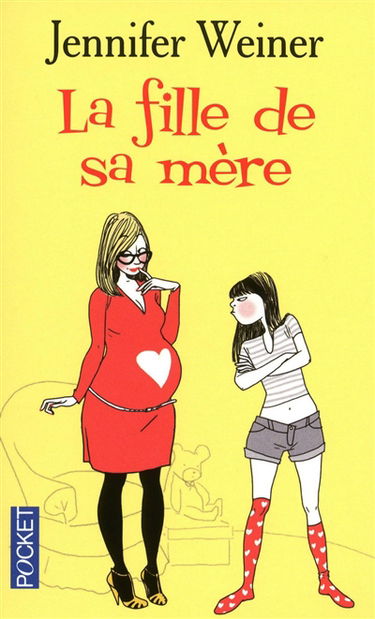
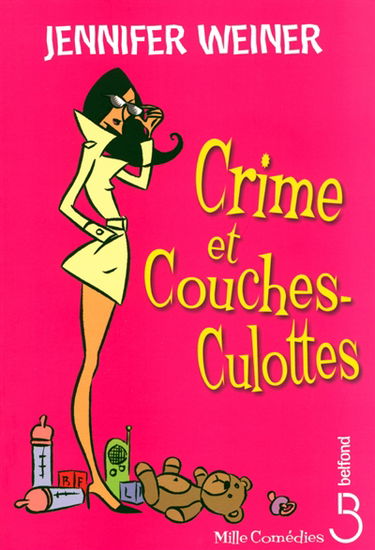
Présentation de l'éditeur Readers fell in love with Cannie Shapiro, the smart, sharp-tongued, bighearted heroine of Good in Bed who found her happy ending after her mother came out of the closet, her father fell out of her life, and her ex-boyfriend started chronicling their ex-sex life in the pages of a national magazine. Now Cannie's back. After her debut novel -- a fictionalized (and highly sexualized) version of her life -- became an overnight bestseller, she dropped out of the public eye and turned to writing science fiction under a pseudonym. She's happily married to the tall, charming diet doctor Peter Krushelevansky and has settled into a life that she finds wonderfully predictable -- knitting in the front row of her daughter Joy's drama rehearsals, volunteering at the library, and taking over-forty yoga classes with her best friend Samantha. As preparations for Joy's bat mitzvah begin, everything seems right in Cannie's world. Then Joy discovers the novel Cannie wrote years before and suddenly finds herself faced with what she thinks is the truth about her own conception -- the story her mother hid from her all her life. When Peter surprises his wife by saying he wants to have a baby, the family is forced to reconsider its history, its future, and what it means to be truly happy. Radiantly funny and disarmingly tender, with Weiner's whip-smart dialogue and sharp observations of modern life, Certain Girls is an unforgettable story about love, loss, and the enduring bonds of family. Extrait Certain Girls ONE When I was a kid, our small-town paper published wedding announcements, with descriptions of the ceremonies and dresses and pictures of the brides. Two of the disc jockeys at one of the local radio stations would spend Monday morning picking through the photographs and nominating the Bow-Wow Bride, the woman they deemed the ugliest of all the ladies who’d taken their vows in the Philadelphia region over the weekend. The grand prize was a case of Alpo. I heard the disc jockeys doing this on my way to school one morning—“Uh-oh, bottom of page J-6, and yes . . . yes, I think we have a contender!” Jockey One said, and his companion snickered and replied, “There’s not a veil big enough to hide that mess.” “Wide bride! Wide bride!” Jockey One chanted before my mother changed the station back to NPR with an angry flick of her wrist. After that, I became more than a little obsessed with the contest. I would pore over the black-and-white head shots each Sunday morning as if I’d be quizzed on them later. Was the one in the middle ugly? Worse than the one in the upper-right-hand corner? Were the blondes always prettier than the brunettes? Did being fat automatically mean you were ugly? I’d rate the pictures and fume about how unfair it was, how just being born with a certain face or body could turn you into a punch line. Then I’d worry for the winner. Was the dog food actually delivered to the couple’s door? Would they return from the honeymoon and find it there, or would a well-meaning parent or friend try to hide it? How would the bride feel when she saw that she’d won? How would her husband feel, knowing that he’d chosen the ugliest girl in Philadelphia on any given weekend, to love and to cherish, until death did them part? I wasn’t sure of much back then, but I knew that when—if—I got married, there was no way I’d put a picture in the paper. I was pretty certain, at thirteen, that I had more in common with the bow-wows than the beautiful brides, and I was positive that the worst thing that could happen to any woman would be winning that contest. Now, of course, I know better. The worst thing would not be a couple of superannuated pranksters on a ratings-challenged radio station oinking at your picture and depositing dog food at your door. The worst thing would be if they did it to your daughter. I’m exaggerating, of course. And I’m not really worried. I looked across the room at the dance floor, just