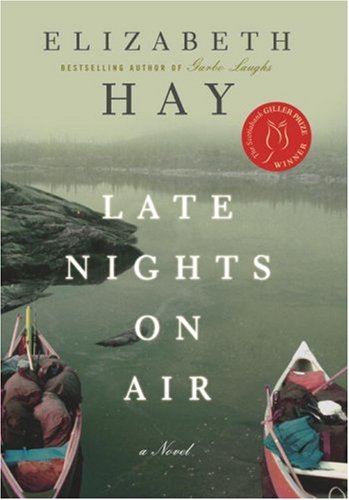
Présentation de l'éditeur
The eagerly anticipated novel from the bestselling author of
A Student of Weather and
Garbo Laughs.
Harry Boyd, a hard-bitten refugee from failure in Toronto television, has returned to a small radio station in the Canadian North. There, in Yellowknife, in the summer of 1975, he falls in love with a voice on air, though the real woman, Dido Paris, is both a surprise and even more than he imagined.
Dido and Harry are part of the cast of eccentric, utterly loveable characters, all transplants from elsewhere, who form an unlikely group at the station. Their loves and longings, their rivalries and entanglements, the stories of their pasts and what brought each of them to the North, form the centre. One summer, on a canoe trip four of them make into the Arctic wilderness (following in the steps of the legendary Englishman John Hornby, who, along with his small party, starved to death in the barrens in 1927), they find the balance of love shifting, much as the balance of power in the North is being changed by the proposed Mackenzie Valley gas pipeline, which threatens to displace Native people from their land.
Elizabeth Hay has been compared to Annie Proulx, Alice Hoffman, and Isabel Allende, yet she is uniquely herself. With unforgettable characters, vividly evoked settings, in this new novel, Hay brings to bear her skewering intelligence into the frailties of the human heart and her ability to tell a spellbinding story. Written in gorgeous prose, laced with dark humour,
Late Nights on Air is Hay’s most seductive and accomplished novel yet.
On the shortest night of the year, a golden evening without end, Dido climbed the wooden steps to Pilot’s Monument on top of the great Rock that formed the heart of old Yellowknife. In the Netherlands the light was long and gradual too, but more meadowy, more watery, or else hazier, depending on where you were. . . . Here, it was subarctic desert, virtually unpopulated, and the light was uniformly clear.On the road below, a small man in a black beret was bending over his tripod just as her father used to bend over his tape recorder. Her father’s voice had become the wallpaper inside her skull, he’d made a home for himself there as improvised and unexpected as these little houses on the side of the Rock — houses with histories of instability, of changing from gambling den to barber shop to sheet metal shop to private home, and of being moved from one part of town to another since they had no foundations.
—
From Late Nights On Air
Extrait
Harry was in his little house on the edge of Back Bay when at half past twelve her voice came over the radio for the first time. A voice unusual in its sound and unusual in itself, since there were no other female announcers on air. He listened to the slow, clear, almost unnatural confidence, the low-pitched sexiness, the elusive accent as she read the local news. More than curious, already in love, he walked into the station the next day at precisely the same time.
It was the beginning of June, the start of the long, golden summer of 1975 when northern light held that little radio station in the large palm of its hand. Eleanor Dew was behind the receptionist’s desk and behind clever Eleanor was the studio. She looked up, surprised. Harry rarely darkened the station door except at night when he came in to do the late shift and got away with saying and playing whatever he liked. He paused beside her desk and with a broad wink asked about the new person on air.
“Hired off the street,” she told him. “The parting shot of our erstwhile manager.”
“Well, well, well,” said Harry.
Despite the red glow of the on-air light, he then pushed through the studio door, only to be met by one of the great mysteries of life. We look so very different from the way we sound. It’s a shock, similar to hearing your own voice for the first time, when you’re forced to wonder how the rest of you comes across if you sound nothing like the way you think