Présentation de l'éditeur
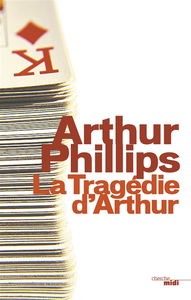
The Tragedy of Arthur is an emotional and elaborately constructed tour de force from “one of the best writers in America” (The Washington Post). Its doomed hero is Arthur Phillips, a young novelist struggling with a con artist father who works wonders of deception. Imprisoned for decades and nearing the end of his life, Arthur’s father reveals a treasure he’s kept secret for half a century: The Tragedy of Arthur, a previously unknown play by William Shakespeare. Arthur and his twin sister inherit their father’s mission: to see the manuscript published and acknowledged as the Bard’s last great gift to humanity . . . unless it’s their father’s last great con. By turns hilarious and haunting, this virtuosic novel, which includes Shakespeare’s (?) lost play in its entirety, brilliantly subverts our notions of truth, fiction, genius, and identity, as the two Arthurs—the novelist and the ancient king—play out their strangely intertwined fates.A New York Times Notable Book • A New Yorker Reviewers’ Favorite of the Year • A Wall Street Journal Best Novel of the Year • A San Francisco Chronicle Best Book of the Year • A Chicago Tribune Favorite Book of the Year • A Library Journal Top Ten Book of the Year • A Kirkus Reviews Best Book of the Year • One of Salon’s five best novels of the yearLook for special features inside. Join the Circle for author chats and more.
Extrait
INTRODUCTION
ARTHUR PHILLIPS
INTERNATIONALLY BESTSELLING AUTHOR OF
Prague, The Egyptologist, Angelica, AND The Song Is You
If you do not feel the impossibility of this speech having been written by Shakespeare, all I dare suggest is that you may have ears—for so has another animal—but an ear you cannot have.
—SAMUEL TAYLOR COLERIDGE, about Henry VI, Part One
•
Shakespeare never did this. He never did this.
—THE BLOW MONKEYS, “Don’t Give It Up”
•
Believe me, my friends, that men, not very much inferior to Shakespeare, are this day being born on the banks of the Ohio.
—HERMAN MELVILLE
•
Phillips himself evidently wanted to carry the performance outside the walls of the playhouse.
—STEPHEN GREENBLATT, Will in the World
1
IHAVE NEVER MUCH LIKED SHAKESPEARE. I find the plays more pleasant to read than to watch, but I could do without him, up to and including this unstoppable and unfortunate book. I know that is not a very literary or learned thing to confess, but there it is. I wonder if there isn’t a large and shy population of tasteful readers who secretly agree with me. I would add that The Tragedy of Arthur is as good as most of his stuff, or as bad, and I suppose it is plausible (vocabulary, style, etc.) that he wrote it. Full disclosure: I state that as the party with the most money to be made in this venture.
As a cab driver asked in an ironic tone when I told him I was contractually bound to write something about Shakespeare, “And what hasn’t been written about him yet?” Perhaps this: although it is probably not evident to anyone outside my immediate family and friends, my own career as a novelist has been shadowed by my family’s relationship to Shakespeare, specifically my father and twin sister’s adoration of his work. A certain amount of cheap psychology turns out to be true: because of our family’s early dynamics, I have as an adult always tried to impress these two idealized readers with my own language and imagination, and have always hoped someday to hear them say they preferred me and my work to Shakespeare and his.
Even as I write that—as I commit it to print and thereby make it true—I know it is ridiculous. I cannot really feel that I am in competition with this man born four hundred years to the day before me. There is nothing in the clichéd description of him as the greatest writer in the English language that should have anything to do with me, my place in literature, the love of my family, or my own “self-esteem,” to use an embarrassing word stinking of redemp