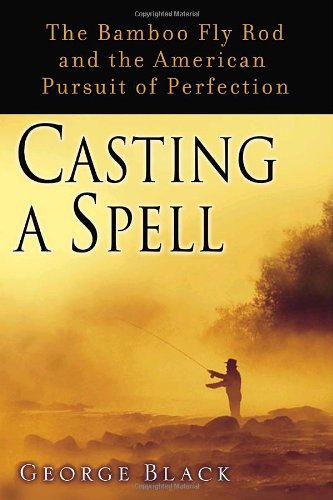
Présentation de l'éditeur
Thirty-five million Americans–one in eight–like to go fishing. Fly fishers have always considered themselves the aristocracy of the sport, and a small number of those devotees, a few thousand at most, insist upon using one device in the pursuit of their obsession: a handcrafted split-bamboo fly rod. Meeting this demand for perfection are the inheritors of a splendid art, one that reveres tradition while flouting obvious economic sense and reaches back through time to touch the hands of such figures as Theodore Roosevelt and Henry David Thoreau.
In Casting a Spell, George Black introduces readers to rapt artisans and the ultimate talismans of their uncompromising fascination: handmade bamboo fly rods. But this narrative is more than a story of obscure objects of desire. It opens a new vista onto a century and a half of modern American cultural history. With bold strokes and deft touches, Black explains how the ingenuity of craftsmen created a singular implement of leisure–and how geopolitics, economics, technology, and outrageous twists of fortune have all come to focus on the exquisitely crafted bamboo rod. We discover that the pastime of fly-fishing intersects with a mind-boggling variety of cultural trends, including conspicuous consumption, environmentalism, industrialization, and even cold war diplomacy.
Black takes us around the world, from the hidden trout streams of western Maine to a remote valley in Guangdong Province, China, where grows the singular species of bamboo known as tea stick–the very stuff of a superior fly rod. He introduces us to the men who created the tools and techniques for crafting exceptional rods and those who continue to carry the torch in the pursuit of the sublime. Never far from the surface are such overarching themes as the tension between mass production and individual excellence, and the evolving ways American society has defined, experienced, and expressed its relationship to the land.
Fly-fishing may seem a rarefied pursuit, and making fly rods might be a quixotic occupation, but this rich, fascinating narrative exposes the soul of an authentic part of America, and the great significance of little things. George Black’s latest expedition into a hidden corner of our culture is an utterly enchanting, illuminating, and enlightening experience.
Extrait
Chapter 1
Wilderness with all the Comforts
My wife’s hometown, Stillwater, Oklahoma—population forty
thousand, home of the Oklahoma State University Cowboys and
the National Wrestling Hall of Fame—is not the kind of place, at
first blush, where you would expect a fly fisherman to have a lifechanging
experience. The old downtown is much like the core of a
lot of American towns whose original logic has been bypassed by
time and Wal-Mart. There are a few bars that cater to the student
clientele from OSU, a couple of banks, an upscale home-furnishing
franchise, a Christian bookstore or two, an ersatz Starbucks, some
boarded-up storefronts, and a multidealer antiques mall, the kind
you see these days in almost every town of comparable size.
The mall is much as you’d expect. Knickknacks and collectibles
of all sorts. The stuff Grandma left in her attic. Used books. Farm
tools, costume jewelry, fifty-cent ties, incomplete sets of glassware.
A room full of ticking wall clocks. Barbie dolls and Star Wars action
figures, as the cutoff line for the term “antique” creeps
steadily forward. And then a dealer’s stand I’d never noticed before:
vintage fishing tackle.
At this point I’d been fly-fishing for three or four years, I suppose—
long enough to graduate to my first hundred-dollar graphite
fly rod and make the transition (in my own mind, at least) from
rank beginner to semicompetent amateur—by which I mean that
once in a while I even caught a few trout. So I stopped to take a
look.
In one corner of the booth was a narrow wooden box about
three feet long, its hinged lid secured with two brass clasps. I
popped them open. In