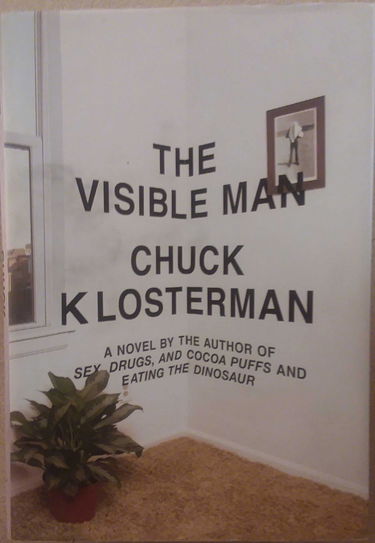
Présentation de l'éditeur
New York Times bestselling author of
Sex, Drugs, and Cocoa Puffs and
Downtown Owl, “the Ethicist” of the
New York Times Magazine, Chuck Klosterman returns to fiction with his second novel—an imaginative page-turner about a therapist and her unusual patient, a man who can render himself invisible.
Therapist Victoria Vick is contacted by a cryptic, unlikable man who insists his situation is unique and unfathomable. As he slowly reveals himself, Vick becomes convinced that he suffers from a complex set of delusions: Y__, as she refers to him, claims to be a scientist who has stolen cloaking technology from an aborted government project in order to render himself nearly invisible. He says he uses this ability to observe random individuals within their daily lives, usually when they are alone and vulnerable. Unsure of his motives or honesty, Vick becomes obsessed with her patient and the disclosure of his increasingly bizarre and disturbing tales. Over time, it threatens her career, her marriage, and her own identity.
Interspersed with notes, correspondence, and transcriptions that catalog a relationship based on curiosity and fear,
The Visible Man touches on all of Chuck Klosterman’s favorite themes—the consequence of culture, the influence of media, the complexity of voyeurism, and the existential contradiction of normalcy. Is this comedy, criticism, or horror? Not even Y__ seems to know for sure.
Extrait
I was physically introduced to Y____ in the most standard of ways: There was a knock at my office door, and I told the knocker to enter. The entrance swung open and a man stepped into the room. I knew who he was before he told me. There were no surprises.
He was a man. A strange-looking man, but nothing more.
He was tall and he was thin. Cadaverous. Perhaps six feet five or six feet six, but no more than 175 pounds. His head was a skull on a stick; it was shaved to the skin, but I could see a subtle shadow where his hair would sprout. The hairline was receding. He wore an oversized black T-shirt, khaki pants, and garish white tennis shoes. His arms were wiry and unnaturally long. His nose was large, as were his Adam’s apple and his ears. His teeth were jagged and yellow. “Ichabod Crane,” I thought to myself. “He looks like an actor auditioning for the role of Ichabod Crane.” It was a sweltering day in May, but he was barely sweating. I can recall this because I asked him where he had parked his car (at the time, I was in the midst of a minor parking dispute with a neighboring office building and lived in constant fear that my patients might get towed). He mentioned that he had arrived on foot. I could not imagine how a man in a black T-shirt could walk any distance in the 90-degree Texas heat without perspiring, but Y____ was immune. When he shook my hand, it was cool and dry, like a brick from the cellar.
I turned on the tape recorder.
When I treat patients in my office, I never sit behind my desk. The desk creates a barrier, and barriers are the enemy. Instead, I sit in a white Eames chair. My patients have the option of sitting in an identical black Eames chair or on the couch. No one ever takes the couch, particularly during their first session (too overt). Y____ looked at both options and requested that he sit in my chair. I said, “No, that’s not how things work here.” I don’t know why I used those specific words. Y____ asked, “Does it matter where I sit? Can’t I sit in the white chair?”
“If it doesn’t matter,” I responded, “then why not sit in the black chair, like everyone else who comes here?”
“Because I have a preference,” said Y____. “I prefer white objects. If I express a preference for white objects, why not allow me to sit in the white chair?”
“Perhaps I have my own preference,” I said.
“Do you have a preference?”
“Yes. I prefer the white chair. The white chair is my preference.”
“Then by all means, take the white chair,” said Y____. “I would never interfere with your pref