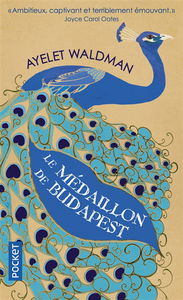
Revue de presse an ambitious, perceptive novel. (Guardian)Ayelet Waldman's new novel, Love and Treasure, places the Hungarian Gold Train at the heart of a multigenerational tale largely set in Salzburg in 1945 and in Budapest, both in the present and in 1913. Crucial to its plot is an enameled pendant, intricately worked in the design of a peacock, unusually colored in purple, white and green. Waldman skillfully interweaves this striking and enigmatic object - a symbol, as the book progresses, of fatal bad luck - into an ambitious sweep of history, setting the loss of millions of human lives against the pendant's own poignant, improbable survival. Waldman sustains her multiple plot lines with breathless confidence and descriptive panache, fashioning complex personalities caught up in an inexorable series of events. (New York Times)By allowing the narrative frames of the novel to interweave different stories and historical tales, Waldman creates a rich tapestry of detail which is both beautiful and heart-wrenching. At times funny, constantly compassionate, Love and Treasure forces you to look at the true value of objects and the worth of a life. A wonderful and extremely precious book. (Press Association)Complex and thoughtful, moving and carefully researched, this is a novel to love and treasure. (Philippa Gregory)stunningly imaginative (Daily Express)Love & Treasure is something of a treasure trove of a novel. Where the opening chapters evoke the nightmare of Europe in the aftermath of World War II with the hallucinatory vividness of Anselm Kiefer's disturbing canvases, the concluding chapters, set decades before, are a bittersweet evocation of thwarted personal destinies that yet yield to something like cultural triumph. Ayelet Waldman is not afraid to create characters for whom we feel an urgency of emotion, and she does not resolve what is unresolvable in this ambitious, absorbing and poignantly moving work of fiction. (Joyce Carol Oates)One is quickly caught up in Love and Treasure with its shifting tones and voices - at times a document, a thriller, a love story, a search - telescoping time backwards and forwards to vividly depict a story found in the preludes and then the after-effects of the Holocaust. Waldman gives us remarkable characters in a time of complex and surprising politics. (Michael Ondaatje)Love & Treasure is like the treasure train it chases: fast-paced, bound by a fierce mission, full of bright secrets and racingly, relentlessly moving. (Daniel Handler (aka Lemony Snicket))Waldman is a wonderfully imaginative writer . . . absorbing . . . As with the painting in Susan Vreeland's Girl in Hyacinth Blue and the manuscript in Geraldine Brooks's People of the Book the link between these separate stories in Love and Treasure is a pendant decorated with the picture of a peacock. In Waldman's exceedingly clever treatment, this piece of jewelry is not intrinsically valuable; it accrues value only as it passes from one unlikely hand to another, demonstrating the curious and tragic ways that history binds us together. . . a tense and romantic story that never seems polemical or overdetermined. . . a marvelous panorama of early 20th-century attitudes about women . . . Moving. (Ron Charles Washington Post)In Ayelet Waldman's thoughtful, expansive Love and Treasure, American soldiers occupying Austria after World War II discover an immense freight train full of personal effects pillaged from Hungarian Jews... Absorbing... The pendant's crooked passage across the century serves as a connecting device, holding the book's elegantly balanced parts together like the wire in a Calder mobile. In the end, Love and Treasure is less concerned with belongings than with belonging - with the Jewish people's ongoing hunt for community and homeland, and what one character calls 'a sense of loyalty and identity.' Those things, once stolen, are much harder to get back. (Sam Sacks Wall Street Journal)What ethics govern the custodia