Résumé
Présentation de l'éditeur
As seen on the cover of the New York Times Book Review, where it was described as “gloriously unsettling… evoking Toni Morrison, Haruki Murakami, Angela Carter, Edgar Allan Poe, Gabriel García Márquez, Chris Abani and even Emily Dickinson,” and already one of the year’s most widely acclaimed novels:
“Helen Oyeyemi has fully transformed from a literary prodigy into a powerful, distinctive storyteller…Transfixing and surprising.”—Entertainment Weekly (Grade: A)
“I don’t care what the magic mirror says; Oyeyemi is the cleverest in the land…daring and unnerving… Under Oyeyemi’s spell, the fairy-tale conceit makes a brilliant setting in which to explore the alchemy of racism, the weird ways in which identity can be transmuted in an instant — from beauty to beast or vice versa.” – Ron Charles, The Washington Post
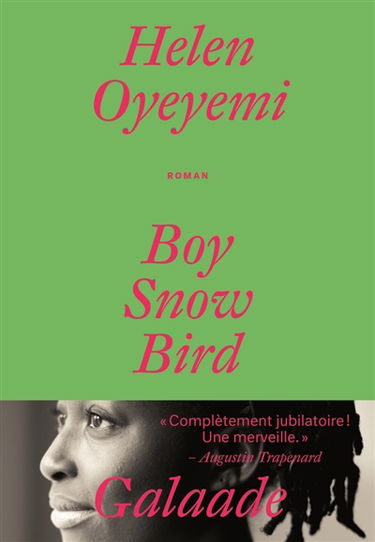
From the prizewinning author of What Is Not Yours Is Not Yours and 2019's Gingerbread, the brilliant recasting of the Snow White fairy tale as a story of family secrets, race, beauty, and vanity.
In the winter of 1953, Boy Novak arrives by chance in a small town in Massachusetts looking, she believes, for beauty—the opposite of the life she’s left behind in New York. She marries Arturo Whitman, a local widower, and becomes stepmother to his winsome daughter, Snow.
A wicked stepmother is a creature Boy never imagined she’d become, but elements of the familiar tale of aesthetic obsession begin to play themselves out when the birth of Boy’s daughter, Bird, who is dark-skinned, exposes the Whitmans as light-skinned African-Americans passing for white. And even as Boy, Snow, and Bird are divided, their estrangement is complicated by an insistent curiosity about one another. In seeking an understanding that is separate from the image each presents to the world, Boy, Snow, and Bird confront the tyranny of the mirror to ask how much power surfaces really hold.
Dazzlingly inventive and powerfully moving, Boy, Snow, Bird is an astonishing and enchanting novel. With breathtaking feats of imagination, Helen Oyeyemi confirms her place as one of the most original and dynamic literary voices of our time.
Extrait
***This excerpt is from an advance uncorrected proof.***
Copyright © 2014 by Helen Oyeyemi
1
Nobody ever warned me about mirrors, so for many years I was fond of them, and believed them to be trustworthy. I’d hide myself away inside them, setting two mirrors up to face each other so that when I stood between them I was infinitely reflected in either direction. Many, many me’s. When I stood on tiptoe, we all stood on tiptoe, trying to see the first of us, and the last. The effect was dizzying, a vast pulse, not quite alive, more like the working of an automaton. I felt the reflection at my shoulder like a touch. I was on the most familiar terms with her, same as any other junior dope too lonely to be selective about the company she keeps.
Mirrors showed me that I was a girl with a white-blond pigtail hanging down over one shoulder; eyebrows and lashes the same color; still, near-black eyes; and one of those faces some people call “harsh” and others call “fine-boned.” It was not unusual for me to fix a scarf around my head and spend an afternoon pretending that I was a nun from another century; my forehead was high enough. And my complexion is unpredictable, goes from near bloodless to scalded and back again, all without my permission. There are still days when I can only work out whether or not I’m upset by looking at my face.
I did fine at school. I’m talking about the way boys reacted to me, actually, since some form of perversity caused me to spend most lessons pretending to absorb much less information than I actually did. Every now and then a teacher got suspicious about a paper I’d turned in and would keep me after school for questioning. “Has someone been . . . helping you?” I just shook my head and shuffled my chair sideways, avoiding the glare of the desk lamp the teacher invariably tri