Présentation de l'éditeur
The instant
New York Times bestselling memoir of a young Jewish woman’s escape from a religious sect, in the tradition of Ayaan Hirsi Ali’s
Infidel and Carolyn Jessop’s
Escape.
The Satmar sect of Hasidic Judaism is as mysterious as it is intriguing to outsiders. In this arresting memoir, Deborah Feldman reveals what life is like trapped within a religious tradition that values silence and suffering over individual freedoms.
Deborah grew up under a code of relentlessly enforced customs governing everything from what she could wear and to whom she could speak to what she was allowed to read. It was stolen moments spent with the empowered literary characters of Jane Austen and Louisa May Alcott that helped her to imagine an alternative way of life. Trapped as a teenager in a sexually and emotionally dysfunctional marriage to a man she barely knew, the tension between Deborah’s desires and her responsibilities as a good Satmar girl grew more explosive until she gave birth at nineteen and realized that, for the sake of herself and her son, she had to escape.
Extrait
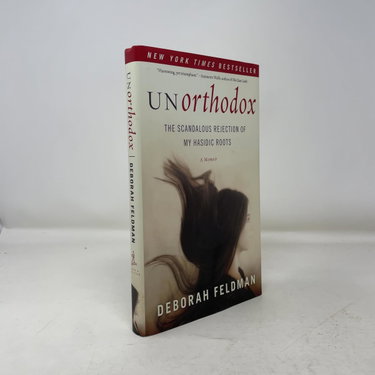
Unorthodox
Prologue
On the eve of my twenty-fourth birthday I interview my mother. We meet at a vegetarian restaurant in Manhattan, one that announces itself as organic and farm-fresh, and despite my recent penchant for all things pork and shellfish, I am looking forward to the simplicity the meal promises. The waiter who serves us is conspicuously gentile-looking, with scruffy blond hair and big blue eyes. He treats us like royalty because we are on the Upper East Side and are prepared to shell out a hundred bucks for a lunch consisting largely of vegetables. I think it is ironic that he doesn’t know that the two of us are outsiders, that he automatically takes our existence for granted. I never thought this day would come.
Before we met, I told my mother that I had some questions for her. Although we’ve spent more time together over the past year than we did in all my teenage years put together, thus far I’ve mostly avoided talking about the past. Perhaps I did not want to know. Maybe I didn’t want to find out that whatever information had been fed to me about my mother was wrong, or maybe I didn’t want to accept that it was right. Still, publishing my life story calls for scrupulous honesty, and not just my own.
A year ago to this date I left the Hasidic community for good. I am twenty-four and I still have my whole life ahead of me. My son’s future is chock-full of possibilities. I feel as if I have made it to the starting line of a race just in time to hear the gun go off. Looking at my mother, I understand that there might be similarities between us, but the differences are more glaringly obvious. She was older when she left, and she didn’t take me with her. Her journey speaks more of a struggle for security than happiness. Our dreams hover above us like clouds, and mine seem bigger and fluffier than her wispy strip of cirrus high in a winter sky.
As far back as I can remember, I have always wanted everything from life, everything it can possibly give me. This desire separates me from people who are willing to settle for less. I cannot even comprehend how people’s desires can be small, their ambitions narrow and limited, when the possibilities are so endless. I do not know my mother well enough to understand her dreams; for all I know, they seem big and important to her, and I want to respect that. Surely, for all our differences, there is that thread of common ground, that choice we both made for the better.
My mother was born and raised in a German Jewish community in England. While her family was religious, they were not Hasidic. A child of divorce, she describes her young self as troubled, awkward, and unhappy. Her chances of marrying, let alone marrying well, were slim, she tells me. The waiter puts a plate of polenta fries and some black beans in front of her, and she shoves her fork in a fry.
When the choi