Présentation de l'éditeur
NAMED ONE OF THE BEST BOOKS OF THE YEAR BY
Entertainment Weekly • The Boston Globe • Kansas City Star
“A legal thriller that’s comparable to classics such as Scott Turow’s Presumed Innocent . . . Tragic and shocking, Defending Jacob is sure to generate buzz.”—Associated Press
NEW YORK TIMES BESTSELLER
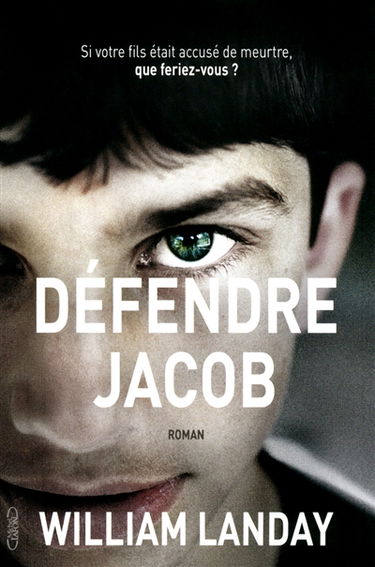
Andy Barber has been an assistant district attorney for two decades. He is respected. Admired in the courtroom. Happy at home with the loves of his life, his wife, Laurie, and teenage son, Jacob.
Then Andy’s quiet suburb is stunned by a shocking crime: a young boy stabbed to death in a leafy park. And an even greater shock: The accused is Andy’s own son—shy, awkward, mysterious Jacob.
Andy believes in Jacob’s innocence. Any parent would. But the pressure mounts. Damning evidence. Doubt. A faltering marriage. The neighbors’ contempt. A murder trial that threatens to obliterate Andy’s family.
It is the ultimate test for any parent: How far would you go to protect your child? It is a test of devotion. A test of how well a parent can know a child. For Andy Barber, a man with an iron will and a dark secret, it is a test of guilt and innocence in the deepest sense.
How far would you go?
Praise for Defending Jacob
“Ingenious . . . Nothing is predictable. All bets are off.”—The New York Times
“Stunning . . . a novel that comes to you out of the blue and manages to keep you reading feverishly until the whole thing is completed.”—The Huffington Post
“Gripping, emotional murder saga . . . The shocking ending will have readers pulling up their bedcovers to ward off the haunting chill.”—People
“The hype is justified. . . . Exceptionally serious, suspenseful, engrossing.”—The Washington Post
“Even with unexpected twists and turns, the two narratives interlock like the teeth of a zipper, building to a tough and unflinching finale. This novel has major motion picture written all over it.”—The Boston Globe
“Yes, this book came out in January. No, we are not done talking about it.”—Entertainment Weekly
Extrait
Chapter 1
In the Grand Jury
Mr. Logiudice: State your name, please.
Witness: Andrew Barber.
Mr. Logiudice: What do you do for work, Mr. Barber?
Witness: I was an assistant district attorney in this county for 22 years.
Mr. Logiudice: "Was." What do you do for work now?
Witness: I suppose you'd say I'm unemployed.
In April 2008, Neal Logiudice finally subpoenaed me to appear before the grand jury. By then it was too late. Too late for his case, certainly, but also too late for Logiudice. His reputation was already damaged beyond repair, and his career along with it. A prosecutor can limp along with a damaged reputation for a while, but his colleagues will watch him like wolves and eventually he will be forced out, for the good of the pack. I have seen it many times: an ADA is irreplaceable one day, forgotten the next.
I have always had a soft spot for Neal Logiudice (pronounced la-JOO-dis). He came to the DA's office a dozen years before this, right out of law school. He was twenty-nine then, short, with thinning hair and a little potbelly. His mouth was overstuffed with teeth; he had to force it shut, like a full suitcase, which left him with a sour, pucker-mouthed expression. I used to get after him not to make this face in front of juries-nobody likes a scold-but he did it unconsciously. He would get up in front of the jury box shaking his head and pursing his lips like a schoolmarm or a priest, and in every juror there stirred a secret desire to vote against him. Inside the office, Logiudice was a bit of an operator and a kiss-ass. He got a lot of teasing. Other ADAs tooled on him endlessly, but he got it from everyone, even people who worked with the office at arm's length-cops, clerks, secretaries, people who did not usually make their contempt for a prosecutor quite so obvious. They called him Milhouse, after a dweeby character on The Simpsons, and they came up with a thousand variations on