Présentation de l'éditeur
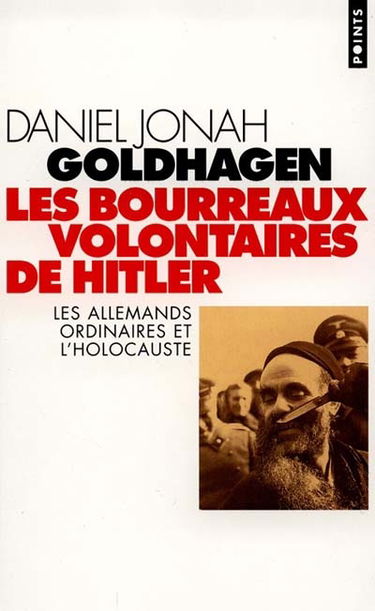
A work of the utmost importance--as authoritative as it is explosive--Hitler's Willing Executioners will fundamentally change our perception of the Holocaust and of Germany in the Nazi period. Goldhagen reaches conclusions that are both uncompromising and savage, rejecting as inadequate the conventional historical explanations for how an entire country could allow the Holocaust to happen, and gives the first detailed, broad-ranging account of the actual killers of the Jews. 31 photos.
Extrait
1
RECASTING THE VIEW OF ANTISEMITISM: A FRAMEWORK FOR ANALYSIS
In thinking about German antisemitism, people have a tendency to make important, unacknowledged assumptions about Germans before and during the Nazi period that bear scrutiny and revision. The assumptions are ones that people would not adopt for investigating a preliterate group in Asia or fourteenth-century Germans, yet which they do for the study of nineteenth- and twentieth-century Germany. They can be summed up as follows: Germans were more or less like us or, rather, similar to how we represent ourselves to be: rational, sober children of the Enlightenment, who are not governed by "magical thinking," but rooted in "objective reality." They, like us, were "economic men" who, admittedly, sometimes could be moved by irrational motives, by hatreds, produced by economic frustrations or by some of the enduring human vices like the lust for power or pride. But these are all understandable; as common sources of irrationality, they seem commonsensical to us.
There are reasons to doubt the validity of such assumptions, as an American educator intimately familiar with Nazi schools and youth cautioned in 1941. Nazi schooling, he averred, "produced a generation of human beings in Nazi Germany so different from normal American youth that mere academic comparison seems inane and any sort of evaluation of the Nazi educational system is extremely difficult." So what justifies the prevailing assumptions about the similarity between us and Germans during the Nazi period and before? Should we not take a fresh look and examine whether or not our notions of ourselves held for Germans in 1890, 1925, and 1941? We readily accept that preliterate peoples have believed trees to be animated by good and evil spirits, capable of transforming the material world, that the Aztecs believed human sacrifices were necessary for the sun to rise, that in the middle ages Jews were seen as agents of the Devil, so why can we not believe that many Germans in the twentieth century subscribed to beliefs that appear to us to be palpably absurd, that Germans too were, at least in one realm, prone to "magical thinking"?
Why not approach Germany as an anthropologist would the world of a people about whom little is known? After all, this was a society that produced a cataclysm, the Holocaust, which people did not predict or, with rare exceptions, ever imagine to have been possible. The Holocaust was a radical break with everything known in human history, with all previous forms of political practice. It constituted a set of actions, and an imaginative orientation that was completely at odds with the intellectual foundations of modern western civilization, the Enlightenment, as well as the Christian and secular ethical and behavioral norms that had governed modern western societies. It appears, then, on the face of it, that the study of the society which produced this then unimagined, and unimaginable, event requires us to question our assumptions about that society's similarity to our own. It demands that we examine our belief that it shared the rational economic orientation that guides social scientific and popular images of our society. Such an examination would reveal that much of Germany did roughly mirror our society, but that important realms of German society were fundamentally different. Indeed, the corpus of German antisemitic literature in the nineteenth and twentieth centuri