Présentation de l'éditeur
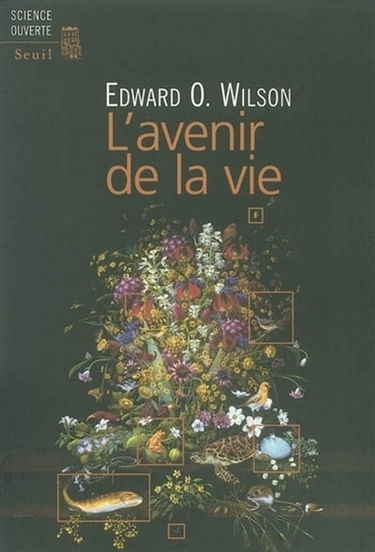
From one of the world’s most influential scientists (and two-time Pulitzer Prize–winning author) comes his most timely and important book yet: an impassioned call for quick and decisive action to save Earth’s biological heritage, and a plan to achieve that rescue.
Today we understand that our world is infinitely richer than was ever previously guessed. Yet it is so ravaged by human activity that half its species could be gone by the end of the present century. These two contrasting truths—unexpected magnificence and underestimated peril—have become compellingly clear during the past two decades of research on biological diversity.
In this dazzlingly intelligent and ultimately hopeful book, Wilson describes what treasures of the natural world we are about to lose forever—in many cases animals, insects, and plants we have only just discovered, and whose potential to nourish us, protect us, and cure our illnesses is immeasurable—and what we can do to save them. In the process, he explores the ethical and religious bases of the conservation movement and deflates the myth that environmental policy is antithetical to economic growth by illustrating how new methods of conservation can ensure long-term economic well-being.
The Future of Life is a magisterial accomplishment: both a moving description of our biosphere and a guidebook for the protection of all its species, including humankind.
Extrait
Chapter 1
TO THE ENDS OF EARTH
The totality of life, known as the biosphere to scientists and creation to theologians, is a membrane of organisms wrapped around Earth so thin it cannot be seen edgewise from a space shuttle, yet so internally complex that most species composing it remain undiscovered. The membrane is seamless. From Everest's peak to the floor of the Mariana Trench, creatures of one kind or another inhabit virtually every square inch of the planetary surface. They obey the fundamental principle of biological geography, that wherever there is liquid water, organic molecules, and an energy source, there is life. Given the near-universality of organic materials and energy of some kind or other, water is the deciding element on planet Earth. It may be no more than a transient film on grains of sand, it may never see sunlight, it may be boiling hot or supercooled, but there will be some kind of organism living in or upon it. Even if nothing alive is visible to the naked eye, single cells of microorganisms will be growing and reproducing there, or at least dormant and awaiting the arrival of liquid water to kick them back into activity.
An extreme example is the McMurdo Dry Valleys of Antarctica, whose soils are the coldest, driest, and most nutritionally deficient in the world. On first inspection the habitat seems as sterile as a cabinet of autoclaved glassware. In 1903, Robert F. Scott, the first to explore the region, wrote, "We have seen no living thing, not even a moss or lichen; all that we did find, far inland among the moraine heaps, was the skeleton of a Weddell seal, and how that came there is beyond guessing." On all of Earth the McMurdo Dry Valleys most resemble the rubbled plains of Mars.
But the trained eye, aided by a microscope, sees otherwise. In the parched streambeds live twenty species of photosynthetic bacteria, a comparable variety of mostly single-celled algae, and an array of microscopic invertebrate animals that feed on these primary producers. All depend on the summer flow of glacial and icefield meltwater for their annual spurts of growth. Because the paths of the streams change over time, some of the populations are stranded and forced to wait for years, perhaps centuries, for the renewed flush of meltwater. In the even more brutal conditions on bare land away from the stream channels live sparse assemblages of microbes and fungi together with rotifers, bear animalcules, mites, and springtails feeding on them. At the top of this rarefied food web are four species of n